The Science of Life and Natural Healing
Ayurveda is one of the world’s oldest holistic healing systems, originating in India more than 5,000 years ago. The word “Ayurveda” is derived from two Sanskrit words — Ayur meaning life and Veda meaning knowledge or science. Together, Ayurveda translates to “The Science of Life.”
Unlike modern medicine that often focuses primarily on treating symptoms, Ayurveda emphasizes maintaining balance in the body, mind, and spirit to prevent illness before it begins. It views health not merely as the absence of disease, but as a state of complete physical, mental, emotional, and spiritual well-being.
Ayurveda combines natural therapies, herbal medicine, nutrition, detoxification, yoga, meditation, breathing techniques, and lifestyle discipline to create harmony within the individual and with nature itself.
Ayurveda believes that every individual is unique and possesses a distinct body constitution known as Prakriti. This constitution is determined by the balance of three fundamental biological energies called the Doshas:
These doshas govern all physical and mental processes in the human body. Health is achieved when the doshas remain balanced. Disease occurs when they become disturbed due to improper diet, stress, unhealthy lifestyle, environmental factors, or emotional imbalance.
Ayurveda aims to identify the root cause of imbalance and restore natural equilibrium through personalized treatment methods.
Vata governs movement in the body, including breathing, circulation, nerve impulses, and digestion.
Ayurveda balances Vata through warm foods, oil therapies, grounding routines, and calming practices.
Pitta controls metabolism, digestion, body temperature, and intelligence.
Cooling foods, meditation, herbal therapies, and stress management help restore Pitta balance.
Kapha provides structure, stability, lubrication, and immunity.
Kapha is balanced through exercise, detoxification, stimulating foods, and active routines.
Ayurveda is based on several key principles that distinguish it from conventional healthcare systems.
Ayurveda strongly emphasizes preventive healthcare. Daily routines, seasonal adjustments, proper nutrition, and mental discipline are considered essential for long-term wellness.
No two individuals are treated the same way. Ayurvedic therapies are customized according to body constitution, age, lifestyle, digestion, emotional state, and environmental conditions.
Ayurveda uses herbs, minerals, oils, therapies, and dietary methods derived from nature to support the body’s natural healing intelligence.
Mental health is deeply connected to physical health in Ayurveda. Emotional stress, fear, anger, and anxiety are considered major contributors to disease.
Ayurvedic practitioners assess health through detailed observation and examination techniques, including:
The purpose is to identify the root imbalance rather than simply suppress symptoms.
In the Ayurvedic paradigm, every individual is governed by a unique ratio of three fundamental bio-energies — the Doshas. Understanding your constitutional blueprint is the first step toward meaningful, lasting healing.
Movement, creativity, nervous energy
Vata governs all forms of motion in the body — from the breath to nerve impulses, muscular movement and the circulation of blood. When in balance, Vata expresses itself as vitality, enthusiasm and creative fluidity. In excess, it manifests as anxiety, restlessness, dry skin, insomnia and joint discomfort.
Transformation, metabolism, intellect
Pitta governs transformation — digestion of food, processing of experience, and the fire of intellect. Balanced Pitta produces sharp cognition, strong digestion and natural leadership. Aggravated Pitta leads to inflammatory conditions, hyperacidity, skin eruptions, irritability and a tendency toward burnout.
Structure, stability, nourishment
Kapha provides the structural integrity of the body — bones, muscles, tendons, and the lubricating fluids of joints and membranes. In harmony, Kapha expresses as strength, endurance, calm and emotional resilience. When aggravated, it manifests as lethargy, weight gain, congestion, fluid retention and emotional heaviness.

Diet plays a central role in Ayurvedic healing. Ayurveda teaches that food can act as medicine when consumed properly.
Ayurveda also recognizes the importance of digestive fire, known as Agni. Strong digestion is considered essential for overall health and vitality.

Ayurveda encourages disciplined daily habits known as Dinacharya.
These may include:
Seasonal lifestyle adjustments (Ritucharya) are also recommended to help the body adapt to environmental changes.
Modern lifestyles often create chronic stress, anxiety, emotional fatigue, and burnout. Ayurveda recognizes that mental peace is essential for physical health.
Through meditation, yoga, herbal support, breathing techniques, and mindful living, Ayurveda aims to calm the nervous system and promote emotional balance.
Ayurvedic psychology also focuses on developing clarity, self-awareness, compassion, discipline, and inner harmony.
Today, Ayurveda is practiced globally as a complementary wellness system. Many people seek Ayurvedic therapies for:
As interest in natural healing grows worldwide, Ayurveda continues to gain recognition for its holistic and personalized approach to health.
Ayurveda is far more than a medical system — it is a philosophy of balanced living. Rooted in harmony between body, mind, spirit, and nature, Ayurveda teaches that true wellness comes from living in alignment with natural principles.
By combining ancient wisdom with healthy lifestyle practices, Ayurveda offers a timeless path toward vitality, balance, and holistic well-being. Whether through herbal remedies, nutrition, detoxification, yoga, meditation, or preventive care, Ayurveda continues to inspire millions seeking a more natural and meaningful approach to health and life.
Each therapy at CS Wellspring is administered by trained Ayurvedic practitioners under the direct supervision of our senior physicians. All herbal oils, decoctions and preparations are compounded in-house using time-honoured classical formulations.
The crown jewel of Ayurvedic therapeutics, Panchakarma is an elaborate, multi-stage detoxification and bio-purification system designed to eliminate deeply embedded metabolic waste from the tissues and restore the body to its constitutional equilibrium.
At CS Wellspring, Panchakarma is never a standardised package — it is an individually calibrated clinical intervention. The process begins with Purvakarma (intensive preparatory procedures including internal oleation with medicated ghee and external oleation with warm herbal oils), followed by the main Pradhana Karma — which may include Vamana (therapeutic emesis), Virechana (purgation therapy), Basti (medicated enema), Nasya (nasal administration) and Raktamokshana (blood purification) — each selected and sequenced based on your diagnosis. The programme concludes with Paschatkarma — a carefully graduated return to normal diet and activity designed to consolidate and protect therapeutic gains.

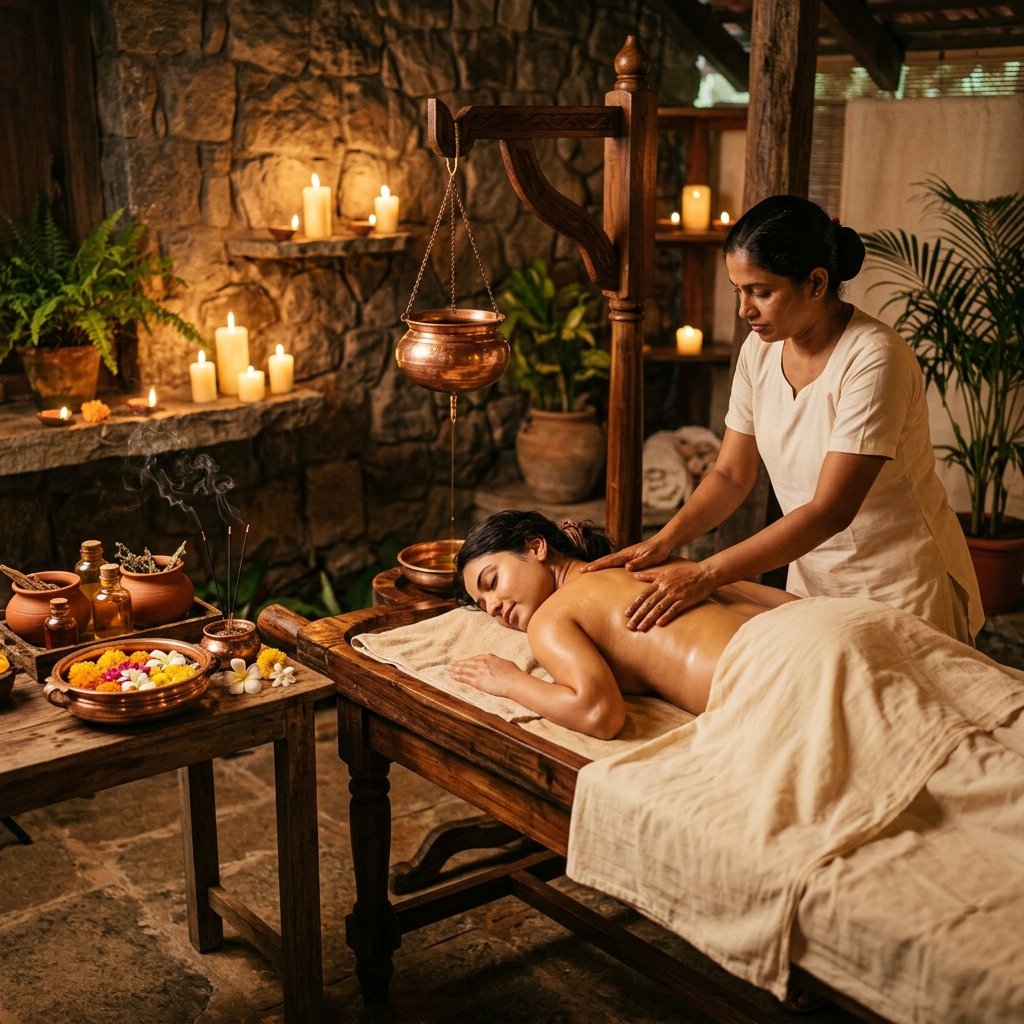
Far more than a massage, Abhyanga is a rhythmic, synchronised application of warm medicated herbal oils performed by two trained therapists working in precise coordination along the body's subtle energy channels.
The selection of oil is itself a clinical decision — Dhanwantharam Thailam for Vata conditions, Kottamchukkadi Thailam for Kapha-related musculoskeletal disorders, Eladi Coconut Oil for Pitta-predominant skin conditions — each formulation carrying the therapeutic intelligence of dozens of precisely combined botanical ingredients. The rhythmic, flowing strokes of Abhyanga liquefy embedded toxins, improve circulatory and lymphatic flow, deeply nourish the skin and subcutaneous tissues, and produce a profound calming of the autonomic nervous system.
One of Ayurveda's most iconic and neurologically potent therapies, Shirodhara involves the continuous, rhythmic pouring of a warm therapeutic liquid — medicated oil, herbal decoction, medicated buttermilk or infused coconut milk — in a gentle, oscillating stream across the forehead.
The point of application corresponds to the Ajna Marma — the classical seat of higher awareness. The steady, unwavering rhythm of the warm liquid creates a deeply meditative neurological response: EEG studies have documented shifts into alpha and theta brainwave dominance during treatment — the same patterns associated with deep meditation and restorative sleep. At CS Wellspring, the choice of medium — whether Ksheeradhara (medicated milk), Takradhara (herbal buttermilk) or Tailadhara (medicated oil) — is determined by your physician based on your constitutional assessment and presenting condition.
Kizhi encompasses a family of therapeutic applications in which specially prepared boluses — cloth bundles filled with medicinal herbs, leaves, powders or specially cooked rice — are warmed in medicated oils and systematically applied to the body in rhythmic, synchronised movements.
At CS Wellspring, we offer several clinically distinct forms of Kizhi, each selected for its specific therapeutic action. Ela Kizhi (Patra Pinda Sweda) uses fresh medicinal leaves and is prescribed for inflammatory joint conditions and muscular stiffness. Njavara Kizhi (Shashtika Shali Pinda Sweda) employs a special variety of medicinal rice cooked in herbal milk — a profoundly nourishing treatment for neuromuscular conditions, wasting diseases and post-stroke rehabilitation. Churna Pinda Sweda utilises finely powdered herbs for conditions involving Kapha-related congestion, obesity and metabolic sluggishness.
Regarded in classical Ayurveda as the most powerful of all Panchakarma interventions, Basti involves the carefully administered introduction of medicated substances — herbal oils, decoctions, or sequential combinations of both — into the colon, the principal site of Vata dosha.
CS Wellspring's Basti protocols are always individually designed and personally supervised by our senior physicians. The formulation, temperature, volume and sequence of each administration are calibrated to your specific diagnosis and stage of treatment. We employ both Anuvasana Basti (oil-based retention enemas for nourishment and Vata pacification) and Niruha Basti (decoction-based therapeutic enemas for elimination and deep cleansing) — often in carefully orchestrated alternating sequences over a period of eight to thirty days.
Nasya is the Ayurvedic therapeutic procedure administered through the nasal passages — the anatomical gateway to the brain, the cranial nervous system and the sensory organs. Precisely formulated herbal oils, fresh juices or fine medicinal powders are introduced into the nasal cavity, where they act directly upon the mucous membranes, sinuses and higher neurological centres.
In Ayurvedic understanding, the nose represents the most direct route to consciousness itself. Nasya therefore occupies a unique position in the treatment of disorders affecting the head, neck, mind and sense organs. At CS Wellspring, Nasya is invariably preceded by a gentle facial massage with warm herbal oil and localised steam fomentation — ensuring that the nasal passages are optimally receptive. The type of Nasya — whether Pratimarsha (mild daily administration), Marsha (intensive therapeutic doses) or Dhuma (herbal smoke inhalation) — is selected by your physician based on the condition being addressed.
Once reserved exclusively for the royalty of Kerala, Pizhichil — also known as Sarvangadhara — is a luxuriously therapeutic procedure in which continuous streams of warm medicated oil are poured rhythmically over the entire body while two therapists simultaneously perform gentle, synchronised massage strokes.
The treatment requires approximately three to four litres of specially prepared medicated oil, warmed to a precisely controlled temperature and continuously recycled throughout the 45- to 60-minute session. The combined effect of sustained warmth, therapeutic touch and the pharmacological action of the herbal oil penetrating through the skin creates a profoundly restorative experience — simultaneously addressing muscular tension, joint stiffness, nervous exhaustion and tissue depletion. At CS Wellspring, Pizhichil is prescribed for conditions involving deep Vata aggravation, neuromuscular degeneration, chronic fatigue and as a supreme rejuvenative (Rasayana) therapy.
Sirovasti is a specialised Ayurvedic therapy in which a precisely constructed reservoir — a tall, open-topped cylindrical cap made from leather or dough — is placed and sealed securely over the crown of the head, then filled with warm medicated oil which is retained for a clinically prescribed duration.
The sustained contact of warm herbal oil with the scalp and the cranial bones beneath produces measurable effects on cerebral circulation, intracranial pressure dynamics and neurological function. At CS Wellspring, Sirovasti is prescribed by our senior physicians for conditions including facial paralysis, severe insomnia, chronic headache syndromes, certain psychiatric presentations, and dry or degenerative conditions of the scalp and hair. The duration of retention — typically between 30 and 60 minutes — and the choice of medicated oil are individually determined based on clinical assessment.
Panchakarma — the crown jewel of Ayurvedic therapeutics — is a systematic, physician-supervised detoxification programme that removes accumulated toxins (Ama) from the deepest tissues of the body, restoring cellular intelligence and constitutional balance.
At CS Wellspring, Panchakarma is administered as a complete clinical programme, not a menu of isolated treatments. Each protocol begins with a thorough Prakriti and Vikriti assessment, followed by a phased approach: Purvakarma (preparatory oleation and fomentation), Pradhanakarma (the five purification procedures), and Paschatkarma (post-treatment dietary and lifestyle rehabilitation). This sequenced approach ensures that detoxification is both thorough and safe — the body is gently prepared before deep cleansing begins, and carefully supported in the days following.
Panchakarma at CS Wellspring is particularly effective for chronic lifestyle disorders, autoimmune conditions, musculoskeletal diseases, neurological disorders, and as a powerful preventive rejuvenation for those who are fundamentally well but depleted by the accumulated stress of modern life.
Physiotherapy at CS Wellspring bridges ancient Ayurvedic movement science with evidence-based contemporary rehabilitation — offering a clinically comprehensive approach to musculoskeletal health, neurological recovery, and functional restoration.
Our team of qualified physiotherapists work in close collaboration with Ayurvedic and naturopathic physicians to design integrated rehabilitation programmes that address the root biomechanical, neurological or inflammatory cause of dysfunction — not merely its symptomatic manifestation. Manual therapy, therapeutic exercise, and electrotherapy modalities are combined with Ayurvedic oil treatments, Yoga therapy and hydrotherapy to accelerate healing and restore full functional capacity.
Physiotherapy at CS Wellspring is particularly effective for post-surgical rehabilitation, chronic pain conditions, sports injuries, neurological recovery (stroke, Parkinson's, multiple sclerosis), and degenerative musculoskeletal conditions such as spondylosis, arthritis and disc disorders. The integration of Ayurvedic oil treatments with physiotherapy — a combination unique to CS Wellspring — dramatically enhances tissue healing and joint mobility outcomes.
At CS Wellspring, Herbal Cosmetology bridges the ancient science of botanical healing with thoughtful, results-driven skincare — completely free of synthetic chemicals, parabens, and artificial fragrances.
Our herbal cosmetology programme draws from the rich Ayurvedic tradition of Kaya Kalpa — the science of body rejuvenation — using time-honoured herbal formulations, plant-based extracts, therapeutic oils and mineral-rich clays to restore radiance, tone and vitality to the skin. Every treatment is prescribed individually, based on the guest's constitution (Prakriti), skin type and specific cosmetic concerns, ensuring that results are authentic and lasting.
Unlike conventional spa treatments that address only the surface, Herbal Cosmetology at CS Wellspring works from the inside out — improving skin health through a combination of external botanical treatments, internal herbal support, dietary guidance and lifestyle adjustment. This holistic approach ensures that the improvements guests experience during their stay continue to deepen after they return home.
Our Ayurvedic physicians will design a programme uniquely matched to your constitution and health goals.
Enquire About Your Programme